Baltimore’s Fells Point neighborhood is known for its bars and restaurants, but tucked a few blocks away from the lively crowds are two small rowhomes with a fascinating story.
Surrounded by gray construction fencing that leaves only their sloping shingled roofs visible, the one-and-a-half story houses might not seem like much. But there’s more to these buildings on South Wolfe Street than meets the eye.
Courtney Capute is a chair of the Friends of the Ship Caulkers’ Houses. Members of the organization are tasked with preserving, restoring, and coming up with a sustainable plan for the houses’ long-term use.
“When research was done on the history and the title of the houses, we realized they have an incredible social history,” Capute said. “Twenty years before the Civil War, two of their residents at the time were freed African American ship caulkers and the more we dug into the history, the ship caulkers played a really critical role in both shipbuilding but also in the Black community at that time.”
Throughout its history, Baltimore has been known as a major shipbuilding city. Back in the 18th and 19th centuries, ships were made out of wood and needed to be caulked to prevent leaks. Ships caulkers filled the spaces between wooden boards with a fiber called oakum, then covered it with pitch and metal.
According to architectural historian Sarah Groesbeck, shipbuilding jobs, like caulking, became important professions to Baltimore’s Black residents at the time.
“Throughout the 19th century and the late 18th century, many of the caulkers that lived in the houses, their families were part of the shipbuilding industry, going back to the 18th century,” Groesbeck said. “Their ancestors were probably enslaved and then they were freed and it became kind of a family legacy that the trade was passed down from generation to generation.”
Baltimore’s caulkers became well-known for the quality of their work.
“There was one article I found that said, ‘We’re known throughout the world. People come here to Baltimore to have their ships caulked by us because they know that we do good work and want it to be done there,’” said Groesbeck.
By the late 1830s, ship caulking in Baltimore became almost exclusively a Black trade. Candi Claggett, an exhibit interpreter at the Calvert Marine Museum, said this was likely due to the Black population’s proximity to the shipbuilding industry.
“The city’s free Black population concentrated around the harbor and also Fells Point where a lot of the shipyards were,” Claggett said. “Black residents, both free and enslaved, made up about one quarter of the city’s residents. Enslaved and free Black workers were key to this early growth.”
Caulking served as a pathway to freedom for enslaved workers and allowed free workers to earn money to help family members buy their freedom.
“So those wages often went to purchase either their own homes, if they could, their freedom, or the freedom of their family members,” Claggett said.
The community of Black Caulkers joined together to form a trade union called the Caulkers Association, which gave them bargaining power, an economic rarity for Black workers at the time.
“In 1838, the Black workers created something called the Caulkers Association, which was one of the nation’s first Black trade unions,” Claggett said. “They were able to band together and negotiate higher wages and then they were also able to determine work conditions as well.”
With the help of the union, by 1850, Black caulkers made $1.75 a day, which was more than Baltimore’s white caulkers were making.
The caulkers also created a beneficial society that helped sick and injured workers and provided other benefits.
“The beneficial society was there to help them, it helped fund education, it helped build a caulkers’ hall so they had their own space for their union,” Groesbeck said. “It also was instrumental in also forming a literary society. So reading and writing and literacy was also very important to them.”
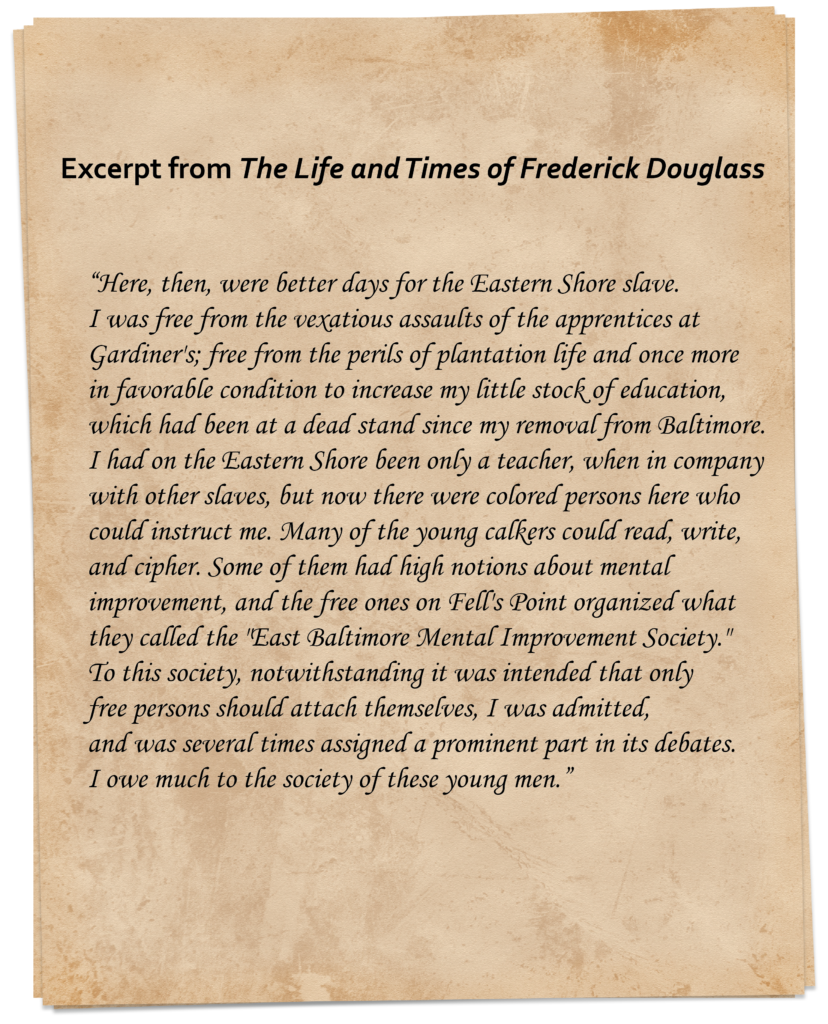
Frederick Douglass is the most well-known Baltimore ship caulker today. When he worked in the shipyards, he took advantage of the caulkers’ societies, like the East Baltimore Mental Improvement Society.
“They were instrumental to helping him read and write, to hone the skills that later would make him famous,” Groesbeck said. “But [they] also were a community for him, where he was able to escape to freedom through the help of this Black community in Fells Point.”
Claggett agrees that Douglass’s time with the ship caulkers helped transform him into the renowned man he came to be.
“If you read his memoir, he really goes into detail about that society and how that kind of boosted his confidence, not only to escape, but to continue to debate because you know he was a great orator,” Claggett said.
Less well-known caulkers, like John Offer and Richard Jones, who lived in the Fells Point houses, are worth remembering too. That’s why the Friends of the Ship Caulkers’ Houses has been tasked with preserving their legacy through restoration.
“We like to say that the way that they’ve survived for so long, and that kind of tenacity that the buildings have really reflects the history of the ship caulkers as well, how they made a life for themselves despite racism in the antebellum, the pre-Civil War period,” Groesbeck said.
After years of neglect, the first step in the preservation process is for C&H Restoration and Renovation to stabilize the houses.
“They’ll be able to stand on their own and then also allow us to do all that finishes on the exterior so siding and doors, windows and roofing that will be appropriate to the period when the ship caulkers lived there,” Groesbeck said.
The goal of the members of the Friends of the Ship Caulkers’ Houses is to allow public access to the houses after the stabilization and exterior restoration work is completed in late summer 2022, so visitors will be able to learn about this important chapter in Baltimore’s history.
“To preserve history of people that once were looked at as less than human and to celebrate their life and legacy is a feat on its own,” Claggett said. “With the constant change of Baltimore City to expand, it’s refreshing to see these historical buildings, especially for the 1700s that once housed African American caulkers, be revived and saved for future generations.”
What’s Beneath the Houses?
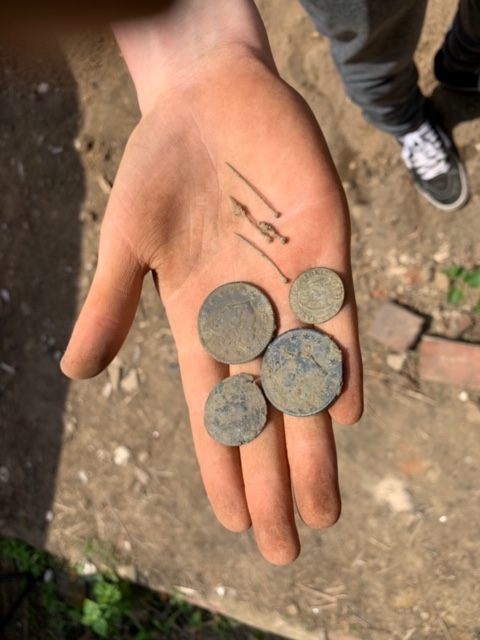
Learn more in this post from the Herring Run Archaeology Project.